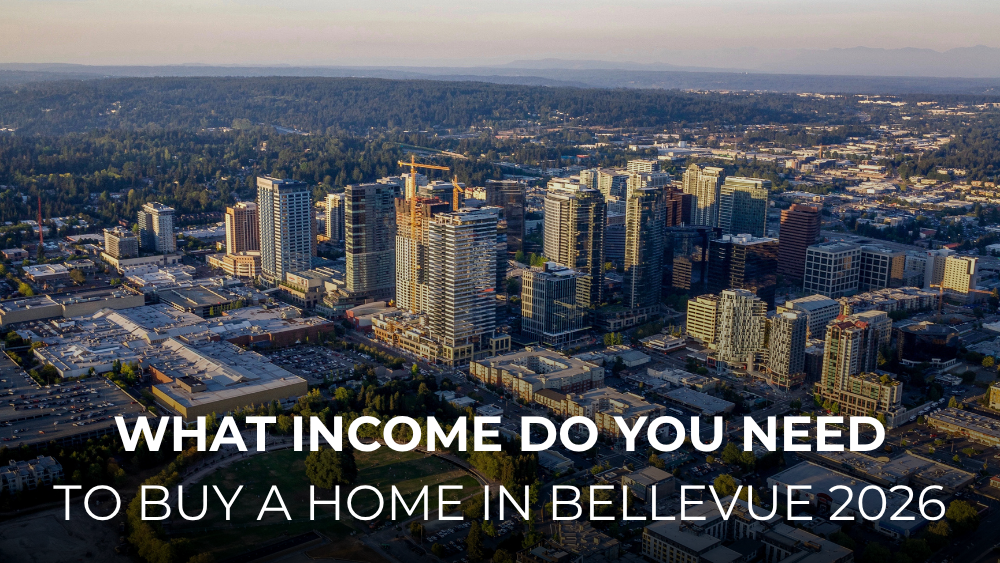
To buy a median-priced home in Bellevue in 2026 with 20% down, most lenders will want to see a household income in the range of $375,000 to $400,000 a year.
That figure comes from the current numbers: Bellevue's median home price is approximately $1.5 million, the 30-year fixed mortgage rate averaged 7.03% as of September 24, 2026, and the resulting payment — principal, interest, property tax and insurance — lands around $9,300 a month. Most lenders look for housing costs at or under roughly 28% of gross monthly income.
That's the median. It is not the entry point. Below, four price points with the actual math, because "what can I afford in Bellevue" has a very different answer depending on which part of the market you're looking at.
The math at four Bellevue price points
All figures assume a 30-year fixed at 7.03%, 20% down, King County property tax at roughly 0.85% of assessed value, and homeowner's insurance in the $100–250 range depending on price. Income shown is what supports the payment at 28% of gross.
| Purchase price | Down payment (20%) | Loan amount | Monthly P&I | Est. taxes + insurance | Total monthly | Income needed |
|---|---|---|---|---|---|---|
| $800,000 (condo or townhome) | $160,000 | $640,000 | $4,271 | ~$680 + HOA | ~$5,450 | ~$234,000 |
| $1,000,000 (older single-family, outer neighborhoods) | $200,000 | $800,000 | $5,338 | ~$880 | ~$6,220 | ~$267,000 |
| $1,250,000 (updated single-family) | $250,000 | $1,000,000 | $6,673 | ~$1,090 | ~$7,760 | ~$333,000 |
| $1,500,000 (median) | $300,000 | $1,200,000 | $8,007 | ~$1,300 | ~$9,307 | ~$399,000 |
Two things this table makes obvious. The gap between an $800,000 condo and a $1.5 million house is not a lifestyle upgrade — it's roughly $165,000 a year in required income. And the down payment at the median, $300,000 in cash, is itself a larger barrier than the monthly payment for most households.
How much does the down payment change the answer?
More than most buyers expect, because a smaller down payment adds private mortgage insurance on top of a larger loan.
On that same $1.5 million home:
| Down payment | Loan amount | Monthly P&I | PMI | Total monthly | Income needed |
|---|---|---|---|---|---|
| 20% ($300,000) | $1,200,000 | $8,007 | none | ~$9,307 | ~$399,000 |
| 10% ($150,000) | $1,350,000 | $9,008 | ~$560 | ~$10,870 | ~$466,000 |
| 5% ($75,000) | $1,425,000 | $9,509 | ~$890 | ~$11,700 | ~$501,000 |
Putting 10% down instead of 20% saves $150,000 in cash at closing and costs roughly $67,000 a year in additional income qualification. For most households that trade isn't available — the income either exists or it doesn't.
This is the arithmetic that pushes a lot of Bellevue buyers toward Kirkland, Redmond, Bothell or Renton. Not preference. Qualification.
What lenders actually look at beyond income
The 28% figure is a guideline, not a rule, and several things move it in both directions.
Your total debt-to-income ratio. Most conventional loans allow total monthly debts — housing plus car payments, student loans, credit card minimums — up to 43–50% of gross income. A household with $400,000 in income and a $4,000 monthly debt load qualifies for meaningfully less than one with the same income and no debts.
Credit score. Above roughly 760 you get the best available pricing. Below 700 the rate climbs, and at a $1.2 million loan a half-point difference is about $400 a month.
Assets after closing. Jumbo loans — which most Bellevue purchases are, since the 2026 conforming limit for King County is well below the median price — typically require reserves, often six to twelve months of payments left in the bank after you close. That's $56,000 to $112,000 sitting untouched on top of your down payment and closing costs.
Income stability and type. W-2 income documented over two years underwrites more easily than self-employment, RSU income or bonus-heavy compensation. Tech households in Bellevue frequently have substantial income in forms lenders treat conservatively. Talk to a lender early if a meaningful share of your compensation is equity.
Should I buy at the top of what I qualify for?
Almost never, and this is the question we'd most like Bellevue buyers to sit with.
Pre-approval tells you the maximum a lender is willing to risk. It does not account for your retirement contributions, childcare or eldercare costs, travel, the fact that your RSU vesting schedule might change, or what a layoff would do to you in a market where the dominant employers are concentrated in one industry.
A useful test: take the payment you're considering and set that exact amount aside every month for three months before you commit. Live on what's left. If it's comfortable, you've confirmed the number. If it's tight, you've learned something at no cost.
The buyers who regret their purchase in this market are almost never the ones who bought less house. They're the ones who bought the maximum and then had one thing change.
What if the income isn't there yet?
Three practical paths, and they're not mutually exclusive.
Look at the adjacent markets. Kirkland, Redmond, Bothell and Renton all offer meaningfully lower entry points with strong school districts and reasonable Eastside commutes. Bothell in particular has been running well below Kirkland for comparable homes.
Look at condos and townhomes in Bellevue itself. An $800,000 Bellevue condo puts you in the school district and the address at roughly 60% of the median income requirement. The tradeoff is HOA dues and less space — but the location is the part that's hard to get later.
Check whether you qualify for down payment assistance. Washington has more programs than most buyers realize, including one specific to East King County that provides up to $30,000. Income limits are higher than people assume — the statewide Home Advantage limit is $215,000.
Frequently asked questions
What is the median home price in Bellevue right now? Approximately $1.5 million as of late 2026, essentially flat year over year. Homes are selling in a median of about eight days with roughly 2.6 months of inventory, which is a seller's market but not an extreme one.
How much do I need to make to buy a $1 million home in Bellevue? Roughly $267,000 in household income with 20% down, at a 7.03% rate. That assumes housing costs at 28% of gross income and no significant other debt. With a car payment and student loans in the picture, the figure climbs.
Can I buy in Bellevue with less than 20% down? Yes. Conventional loans allow as little as 3–5% down, and Washington's down payment assistance programs can help with the rest. The tradeoffs are private mortgage insurance, a larger loan, and a higher income requirement to qualify. Most Bellevue purchases are jumbo loans, which often carry stricter down payment and reserve requirements than conforming loans.
What's the income requirement for an $800,000 Bellevue condo? Around $234,000 with 20% down, before HOA dues. Bellevue condo HOAs commonly run $400–800 a month depending on the building and amenities, and that amount counts toward your housing ratio — so ask for the actual figure on any building you're considering.
Do lenders count RSUs and bonus income? Often, but conservatively and with documentation requirements. Most lenders want a two-year history and evidence the income will continue. If a large share of your compensation is equity, get in front of a lender before you start touring — the answer materially changes your budget and it's better to know early.
Run your actual number, not the median
Every figure above is an illustration built on averages. Your real number depends on your debts, your credit, your down payment, the specific property's taxes and HOA, and what a lender will do with your particular income structure.
We'll sit down with you and a lender and get you a real figure before you start looking — which is the right order, and the opposite of how most people do it.
Schedule a buyer consultation →
Tribeca NW Real Estate serves buyers and sellers across Bellevue, Kirkland, Redmond, Issaquah, Bothell and the greater Seattle metro. 1,675 homes closed and $1B+ in transaction volume. 500+ five-star Google reviews and 375+ five-star Zillow reviews.
This article is general information, not financial or lending advice. Rates, taxes and program terms change. Confirm current figures with a licensed lender before making decisions.
Sources cited in this post:
- Freddie Mac Primary Mortgage Market Survey — 30-year fixed 7.03% as of September 24, 2026
- Bellevue housing market data — Houzeo
- WSHFC down payment assistance programs
Check out this article next