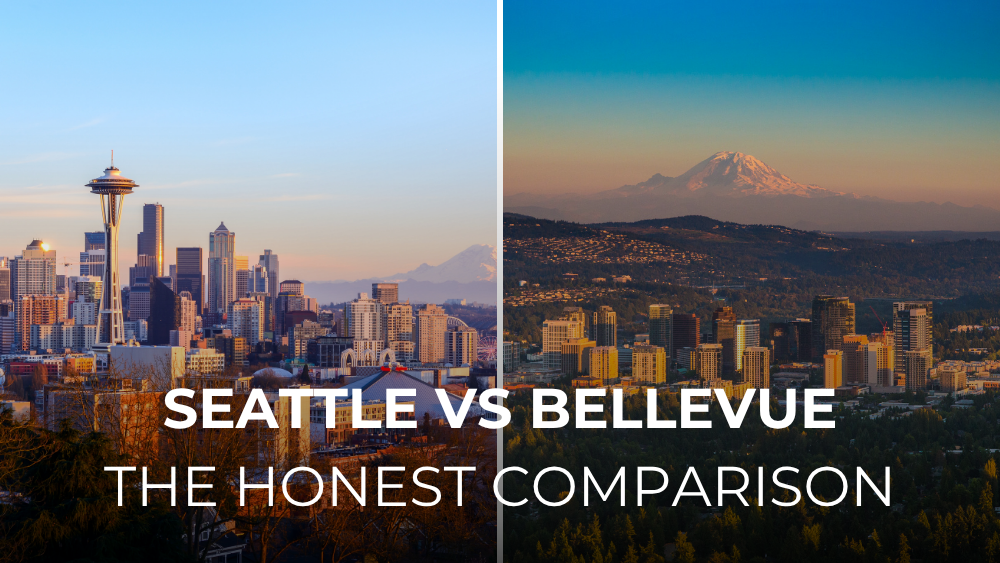
Bellevue and Seattle are the two most common choices for buyers moving to the greater Seattle area — and they're genuinely different cities that serve genuinely different lifestyles. The decision between them isn't really about price (though price matters). It's about what you value in daily life.
This is the honest comparison.
The cost gap — and what it actually represents
The median single-family home price in Seattle sits around $950K–$1.1M depending on neighborhood. In Bellevue, the median is $1.5M–$1.8M. That's a gap of roughly $500K–$700K for a comparable property.
What explains the gap? Three things primarily:
School district quality. The Bellevue School District is one of the top-ranked districts in the country. Seattle's school district is more variable — some schools are excellent, others significantly less so. Families who specifically require BSD access pay the premium for it.
Safety. Bellevue's crime rates are significantly lower than Seattle's across most categories. This is real and measurable, not perception.
Character and infrastructure. Bellevue is newer, cleaner, and more consistently maintained than Seattle. Roads are better. Parks are more consistently managed. The physical quality of the built environment is higher on average.
The question is whether those differences are worth $500K–$700K to you. For some buyers, absolutely. For others, the tradeoff doesn't pencil.
What daily life actually feels like
Life in Seattle
Seattle has something Bellevue doesn't — the texture of a real city. Neighborhood character that developed organically over decades. A dense commercial street like Ballard Avenue or Capitol Hill's Pike/Pine where you know the business owners and they know you. A genuine arts and culture scene. Food markets, live music, independent bookstores, and the kind of street energy that feels alive rather than curated.
The tradeoff is that Seattle requires more navigation. The experience varies dramatically by neighborhood. Property crime rates in some commercial corridors have been meaningfully higher than in Bellevue. And the school district quality is inconsistent enough that buyers with school-age children often feel they're paying Seattle prices for a lottery on school quality.
Seattle is the right choice if: Urban energy, neighborhood character, cultural density, and walkability are high on your priority list. You value the texture of a real city over the consistency of a well-managed suburb. Your employment is in Seattle or remote. You don't have school-age children or have a specific plan for school access.
Life in Bellevue
Bellevue has become a real city — it's not the suburban bedroom community people from outside the region imagine. Downtown Bellevue has a legitimate skyline, genuine restaurant and retail options, and a concentration of Class A employers. The East Link light rail has changed its connectivity profile.
But Bellevue's residential neighborhoods are genuinely suburban. Blocks are wide, streets are designed for cars, and the street-level experience in most neighborhoods requires a car for most daily errands. Outside of downtown and a few specific nodes, you don't bump into neighbors on the street the way you might in Ballard or Fremont.
What Bellevue delivers consistently: one of the country's best school districts, very low crime, excellent infrastructure, proximity to major tech employers, and a quality of daily life that's reliable and predictable.
Bellevue is the right choice if: School district is a primary driver. Safety and infrastructure quality are important to you. Your employment is on the Eastside or you're a tech worker whose office is in Bellevue or Redmond. You're relocating from another high-cost city and want a predictable, high-quality suburban environment.
Schools: the clearest differentiator
This is where the comparison is sharpest.
Bellevue School District (BSD) is consistently ranked among the top 1–2% of school districts nationally. Graduation rates above 95%, strong AP and IB programs at every high school, well-funded facilities, and a college preparation culture that draws families to BSD specifically.
Seattle Public Schools is a larger, more variable district. Some Seattle schools — particularly in the north end — are genuinely excellent. Others significantly underperform. School quality depends heavily on which school your specific address feeds into, and Seattle's open enrollment system makes assignment less predictable than BSD's.
For buyers who want school district certainty, Bellevue wins clearly. For buyers who are willing to navigate Seattle's school system and have a plan for school access, the premium isn't necessarily worth it.
Safety: the honest conversation
Bellevue consistently ranks among the safest large cities in the United States. Property crime rates are well below national averages. Violent crime is rare. The city is well-maintained and the visible indicators of community health — clean streets, maintained parks, engaged neighbors — are consistently positive.
Seattle has had well-documented challenges with property crime, visible homelessness, and public safety in certain commercial corridors and neighborhoods. These challenges are real and affect daily life in ways that differ meaningfully by neighborhood. Capitol Hill and downtown Seattle have seen more significant issues than Queen Anne or Laurelhurst.
This doesn't mean Seattle is unsafe — millions of people live there safely and happily. But the gap in safety metrics between Bellevue and Seattle is real and is one of the most commonly cited reasons buyers choose Bellevue.
Commute: who's commuting where
If you work in Seattle: Living in Bellevue means a commute — SR-520 or I-90 across the lake, plus navigation on the Seattle side. Off-peak this is 15–25 minutes. During peak hours it's 35–55 minutes. The East Link light rail changes this calculation for buyers near a station.
If you work in Bellevue or on the Eastside: Living in Seattle means crossing the bridge in the other direction. Off-peak 15–25 minutes. Peak hour 35–55 minutes. Many Seattle residents who work on the Eastside find the commute workable.
If you work remotely: The commute question becomes a lifestyle question. Do you want urban energy or suburban predictability?
The "how locals refer to Bellevue" question
This shows up in search data constantly — people wondering if Bellevue has a nickname or how locals refer to it. The honest answer: people just call it Bellevue. There's no widespread local nickname the way some cities have. Seattle locals sometimes call it "the Eastside" when referring to the broader corridor, but Bellevue itself is just Bellevue.
The verdict
There is no universal right answer. There's only the right answer for your situation.
Run your own version of this comparison:
- What does your school situation look like, and how does that change the math?
- Where are you commuting to?
- What does your daily life actually need — urban energy or suburban predictability?
- What does the $500K price gap mean for your financial situation?
The buyers we've seen make the most confident decisions are the ones who spent time in both cities — not just looking at listings, but driving the neighborhoods, visiting coffee shops, and walking the streets on a Tuesday evening before they committed.
We know both sides of the lake
At Tribeca NW, our agents serve buyers across both Seattle and the Eastside. We can help you see both markets honestly and make a decision based on what your life actually looks like — not what sounds better on paper.
Talk to a Tribeca NW agent about Seattle vs. Bellevue →
Related reading: Living in Bellevue, WA in 2026 — the honest guide → | Best neighborhoods in Seattle → | Seattle vs. Bellevue commute showdown →
Tribeca NW Real Estate serves buyers and sellers across Seattle, Bellevue, Kirkland, Redmond, and the greater metro area. 1,508 homes closed. 800+ five-star reviews on Google and Zillow.
Check out this article next