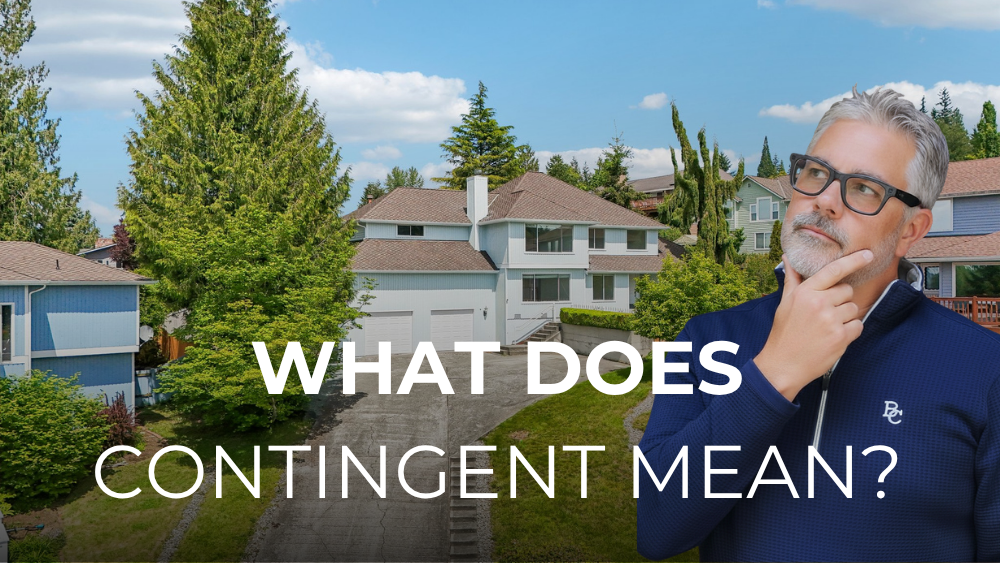
What Does Contingent Mean in Real Estate? A Plain-English Guide for Buyers
You're scrolling through listings, you find one that checks every box — and then you see the word "contingent" next to the price. Does that mean it's gone? Can you still make an offer? Should you even bother?
The short answer is: it depends. And understanding exactly what contingent means — and what it doesn't — could be the difference between walking away from a great home and landing it.
What "contingent" means
In real estate, a property listed as contingent means the seller has accepted an offer, but the sale isn't final yet. The transaction is "contingent" — dependent — on one or more conditions being met before it can close.
Think of it as a conditional yes. The seller said yes to a buyer, but that yes has strings attached. If those conditions aren't met within the agreed timeframe, the contract can fall apart — and the home comes back on the market.
The most common types of contingencies
Not all contingencies are the same. Here are the ones you'll encounter most often in Washington State:
Inspection contingency The buyer has the right to conduct a professional home inspection within a specified period (usually 5–10 business days). If the inspection reveals significant problems, the buyer can request repairs, negotiate a price reduction, or walk away entirely. This is the most common contingency and one of the most important protections a buyer has.
Financing contingency The purchase is contingent on the buyer securing a mortgage loan. If the lender ultimately declines to fund — or if the home doesn't appraise at the purchase price — the buyer can exit the contract without losing their earnest money. On the Eastside, where purchase prices are high, financing contingencies are standard even for well-qualified buyers.
Appraisal contingency Related to financing, this protects buyers if the home appraises below the agreed purchase price. If a home sells for $1.1M but appraises at $1.05M, the lender will only finance based on the lower value. An appraisal contingency lets the buyer renegotiate or exit rather than being forced to cover the gap out of pocket.
Home sale contingency Some buyers need to sell their current home before they can purchase a new one. A home sale contingency makes the purchase dependent on that sale completing. Sellers are less fond of this contingency because it introduces uncertainty — and in a competitive market, buyers who can offer without it have an advantage.
Title contingency This ensures the property has a clean title — no liens, disputes, or ownership issues that would cloud the buyer's ownership. Title contingencies are standard and rarely cause issues, but they matter when they do.
What "contingent" looks like in practice on the Eastside
In the Bellevue, Kirkland, and Redmond markets, contingencies play out a bit differently than in slower markets.
During peak season (February through July), well-priced homes often receive multiple offers within days. Some buyers waive inspection contingencies to make their offers more competitive — a risky move that we generally advise against unless you have high confidence in the home's condition and have done a pre-inspection walkthrough.
Financing contingencies are almost always included, even by buyers with strong pre-approval letters. The gap between a pre-approval and a funded loan is real, and protecting yourself from that gap is worth the slight competitive disadvantage.
Appraisal contingencies have become a more nuanced negotiating point. In competitive situations, buyers sometimes agree to cover a certain appraisal gap (say, up to $50,000 above appraised value) while retaining the right to exit if the gap exceeds that amount.
Can you make an offer on a contingent home?
Yes — in many cases, you can. Washington State allows sellers to continue accepting backup offers even after a home is listed as contingent. If the primary offer falls apart (which happens more than buyers expect — roughly 5–10% of contingent contracts fail to close), the seller can move to the backup offer without relisting.
Submitting a backup offer on a contingent home is a legitimate strategy, especially if:
- The home has been contingent for longer than typical (suggesting the primary deal may be struggling)
- The contingency type is a financing or sale contingency, which have higher fallout rates than inspection-only
- You've already lost out on similar homes and want to be positioned when one becomes available
Your agent should be tracking contingent listings in your target neighborhoods and watching for status changes. At Tribeca NW, this is standard practice — we don't just find you listings, we monitor the pipeline.
Contingent vs. pending: what's the difference?
These two statuses are often confused. Here's the distinction:
Contingent means the seller has accepted an offer, but conditions still need to be met. The deal is not yet locked.
Pending means the contingencies have been cleared or waived, and the transaction is in its final stages moving toward closing. A pending sale is much harder to disrupt than a contingent one.
As a buyer, a contingent listing is worth watching. A pending listing is almost always off the table.
What this means for your buying strategy
Understanding contingency status turns you from a passive listing browser into a strategic buyer. Instead of dismissing every contingent home as unavailable, you're evaluating each one: what type of contingency is it? How long has it been contingent? Is there a reason this deal might fall through?
The buyers who land great homes on the Eastside aren't always the ones who move fastest on day one — they're also the ones who stay sharp and positioned when a contingent deal collapses and a home suddenly becomes available.
Work with agents who know how to navigate contingencies
At Tribeca NW, we've helped buyers successfully acquire homes that were contingent when we first identified them. We've also helped sellers structure contingency terms that protect their interests without scaring away qualified buyers.
If you're navigating the Eastside market and want a clear-eyed partner who knows how each status affects your strategy, we'd love to talk.
Connect with a Tribeca NW buyer agent →
Tribeca NW Real Estate serves buyers and sellers across Bellevue, Kirkland, Redmond, and the greater Eastside. 1,508 homes closed. 800+ five-star reviews on Google and Zillow.
Check out this article next