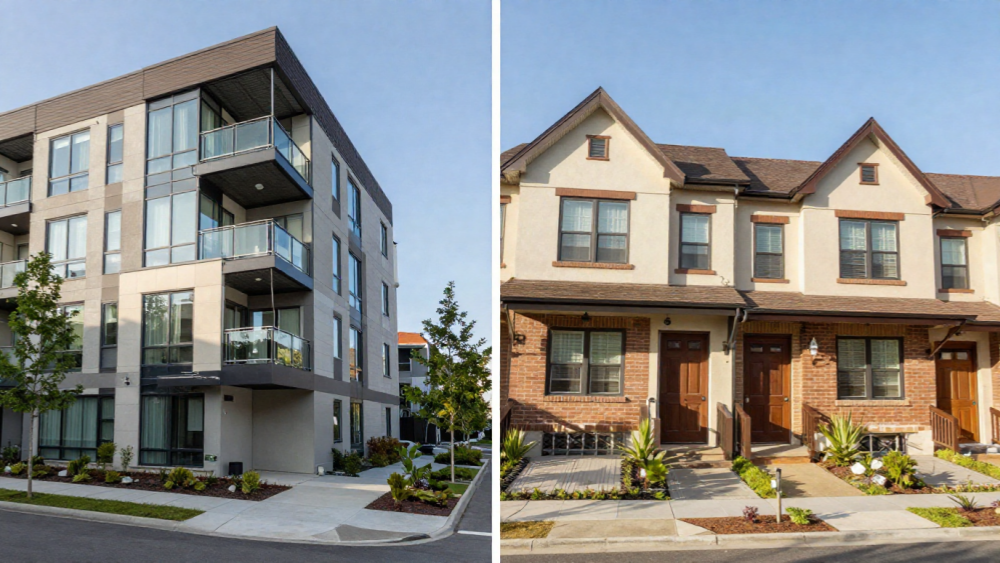
For buyers in the $550K–$900K range on the Eastside, the condo vs. townhouse question comes up constantly. Both offer an alternative to the single-family home — more accessible price points, less exterior maintenance, often better locations relative to employment and amenities. But they're not the same product, and the differences matter more than most buyers realize before they're already under contract.
Here's what you need to know before you decide.
The core difference: what you actually own
This is the foundational distinction, and it affects everything downstream.
Condo ownership When you buy a condo, you own the interior space of your unit — essentially, the air inside the walls. The building structure, exterior, roof, hallways, parking structure, and common areas are owned collectively by all unit owners and managed by a homeowners association (HOA). You have a percentage share of the common elements, but no individual ownership of the land or building shell.
Townhouse ownership When you buy a townhouse, you typically own the structure itself — walls, roof, and often the land beneath it — as an individual owner. You still share some common elements (driveways, landscaping, shared walls) that an HOA manages, but your ownership is more like a traditional home than a condo. You hold title to a piece of real property, not just interior space.
This distinction matters most when something goes wrong. A major roof repair in a condo building is an HOA expense, spread across all owners. A roof issue on a townhouse you own is your expense.
HOA fees: what you're actually paying for
Both condos and townhouses typically come with HOA fees, but they function differently.
Condo HOA fees tend to be higher because they cover more. Your monthly payment likely includes: building insurance (often for the entire structure), exterior maintenance and repairs, roof, elevators, common area cleaning, and often utilities like water and trash. Some condo HOAs also include internet or basic cable. The tradeoff for higher fees is that you're genuinely outsourcing almost all exterior maintenance responsibility.
Townhouse HOA fees are often lower because they cover less. You're typically paying for shared landscaping, driveway maintenance, and sometimes the exterior of the building — but you carry more individual responsibility for your own unit's systems, roof, and structure.
On the Eastside specifically, condo HOA fees in Bellevue range from roughly $300–$700/month depending on the building's age, amenities, and reserve fund status. Townhouse HOAs in Kirkland and Redmond typically run $150–$350/month.
Before purchasing either, always review: the HOA's reserve fund balance (a healthy reserve means lower risk of special assessments), any pending special assessments, and the HOA's meeting minutes from the past year. Issues tend to show up there before they show up in the listing.
Space and layout
This is where townhouses tend to win for buyers who need more room.
Condos are typically single-story or occupy a portion of a floor in a multi-story building. You get horizontal space, but usually no private outdoor area beyond a balcony. Storage is often limited. Garages, when they exist, are shared structures with assigned spaces rather than attached private garages.
Townhouses are typically multi-story — two or three floors — with a more house-like feel. Many have attached garages (often a significant selling point on the Eastside), small private yards or patios, and more separation from neighbors despite sharing walls. If you have children, pets, or simply want more room to spread out, townhouses typically offer a more livable experience at a comparable price point.
The tradeoff: stairs. Townhouses with three stories can mean a lot of vertical movement in daily life, and the layout is less accessible for buyers with mobility considerations.
Privacy and noise
Condos share horizontal neighbors — the people above you, below you, and beside you. Sound travels through floors and ceilings in ways that shared walls do not. In well-built modern buildings, sound insulation is much better. In older buildings, it can be a real quality-of-life issue. Research the building's construction quality and read reviews from current owners if you can.
Townhouses share vertical walls with neighbors on one or both sides. This is generally easier to live with than floor/ceiling neighbors in a condo. You typically don't hear footsteps, furniture scraping, or someone's television through a shared wall the way you might through a shared floor. You also have a defined front door and private entrance, which adds to the sense of living in a home rather than a unit.
Financing differences
Lenders treat condos and townhouses differently, and this can affect your loan terms.
Townhouses finance much like single-family homes. Standard conventional, FHA, and VA loans apply without the additional scrutiny that condos face.
Condos are subject to additional lender review. Lenders evaluate not just you as a borrower, but the condo association's financial health, owner-occupancy ratio, pending litigation, and insurance coverage. Condo buildings that fail lender guidelines (called "non-warrantable" condos) may require portfolio loans with higher interest rates or larger down payments. Before falling in love with a specific condo, confirm it's warrantable with your lender.
Resale value on the Eastside
Both condos and townhouses in Bellevue, Kirkland, and Redmond have appreciated significantly over the past decade. However, a few patterns are worth noting:
Single-family homes have consistently outperformed condos in appreciation on the Eastside — the land component drives long-term value in a supply-constrained market.
Townhouses tend to track closer to single-family homes in appreciation because they include land ownership and have more house-like characteristics.
Well-located condos in desirable buildings (downtown Bellevue, Kirkland waterfront area) hold value strongly and offer a lifestyle premium that justifies the price for certain buyers.
The weakest-appreciating segment has historically been older condo buildings with high HOA fees, aging infrastructure, and limited amenity differentiation.
Which is right for you?
Choose a condo if:
- Minimizing maintenance responsibility is a priority
- You want urban walkability and are comfortable with a higher HOA in exchange for amenities and location
- You're purchasing as an investment and the rental market in that building is strong
- You don't need outdoor space or multiple stories
Choose a townhouse if:
- You need more square footage and a more house-like layout
- You have children or pets who benefit from private outdoor space and a garage
- You want to own land and the structure, not just interior space
- You're planning to stay for 7+ years and want stronger appreciation potential
We can help you evaluate both
The right choice depends on your specific situation — timeline, budget, family needs, and how you weigh monthly costs vs. long-term equity. At Tribeca NW, we've helped hundreds of buyers navigate this exact decision across the Eastside and can show you comparable options side by side in the same week.
Schedule a free buyer consultation with Tribeca NW →
Tribeca NW Real Estate serves buyers across Bellevue, Kirkland, Redmond, and the greater Eastside. 1,508 homes closed. 800+ five-star reviews on Google and Zillow.
Check out this article next