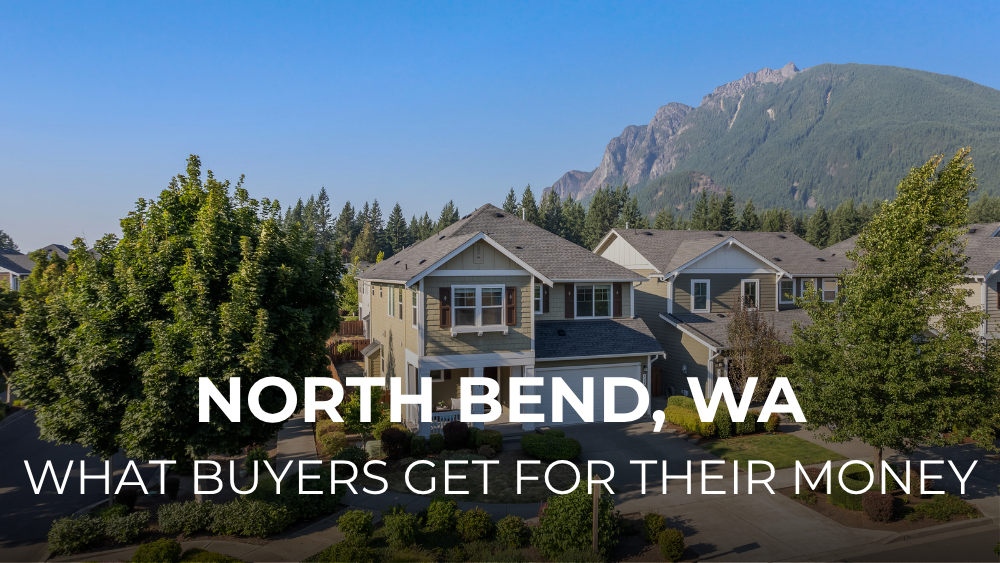
North Bend's median sale price reached $1,284,301 in mid-2026, up 40.4% year over year, with homes going pending in a median of nine days at 100.5% of list price — above asking, on average.
Before you conclude North Bend has become unaffordable, read the number carefully. A 40% jump in a town this size is almost never a 40% jump in what any individual house is worth. It usually reflects what sold — and North Bend has had significant newer construction come through, which shifts the median upward without every existing home appreciating by the same amount. The nine-day pace and the above-asking ratio are the more reliable signals, and both say demand here is real.
The numbers
| Metric | North Bend | Bellevue (for reference) |
|---|---|---|
| Median sale price | $1,284,301 | ~$1,500,000 |
| Year-over-year change | +40.4% | ~0% |
| Median days on market | 9 | ~8 |
| Sale-to-list ratio | 100.5% | — |
| Data through | June 2026 | Late 2026 |
The comparison that matters: North Bend is now within about $215,000 of Bellevue's median. Five years ago that gap was far wider. The traditional pitch for North Bend — substantially more house and land for substantially less money — has narrowed considerably, and buyers running on old assumptions should recalibrate.
What you still get for the difference is space, setting, and a lot size that Bellevue cannot offer at any comparable price.
Why people buy in North Bend
Mountain access from the front door. Mount Si, Rattlesnake Ledge, Little Si, and the Middle Fork Snoqualmie corridor are minutes away, not an hour. For buyers who hike, climb or ski regularly, this is the entire argument — Snoqualmie Pass is roughly 30 minutes east.
Land. Lot sizes here bear no resemblance to the Eastside core. Properties with real yards, outbuildings and forest edges are ordinary rather than exceptional.
The I-90 position. North Bend sits directly on the interstate, which makes the Bellevue and Issaquah commute straightforward off-peak and manageable at peak — better than the surface-road commutes from the northern valley towns.
Newer construction. North Bend has had meaningful new residential development, which means buyers can find modern systems, current insulation standards and open floor plans without the renovation project that a comparable Bellevue price point would require.
The town itself. A real downtown, a grocery store, restaurants, the outlet mall, and a genuine small-town identity that's distinct from being a subdivision attached to a larger city.
The honest tradeoffs
The commute is real at rush hour. Off-peak, North Bend to downtown Bellevue is about 30 minutes. Westbound I-90 at 7:30 a.m. is a different experience, and the corridor has limited alternatives when there's an incident. Drive it at your actual hour before you commit, both directions.
Weather is genuinely different. North Bend sits at the base of the Cascades and gets more rain and more snow than Bellevue, 25 miles west. Winter here means occasional snow accumulation, chains in the car, and a different relationship with your driveway. Some buyers love this. Others are surprised by it in January.
Fewer amenities. One grocery store of scale. Limited dining compared to the Eastside. Medical care, specialty retail and most services mean driving to Issaquah or Bellevue.
Flood and landslide considerations. The Snoqualmie River runs through the area and parts of the valley carry flood exposure. Check FEMA flood maps and King County geologic hazard data for the specific parcel — it affects insurance and sometimes financing.
Tourism traffic. Snoqualmie Falls, Mount Si and the Twin Peaks pilgrimage bring significant weekend visitors. Summer Saturdays on the main routes are busier than residents would prefer.
What $1.28 million actually buys here
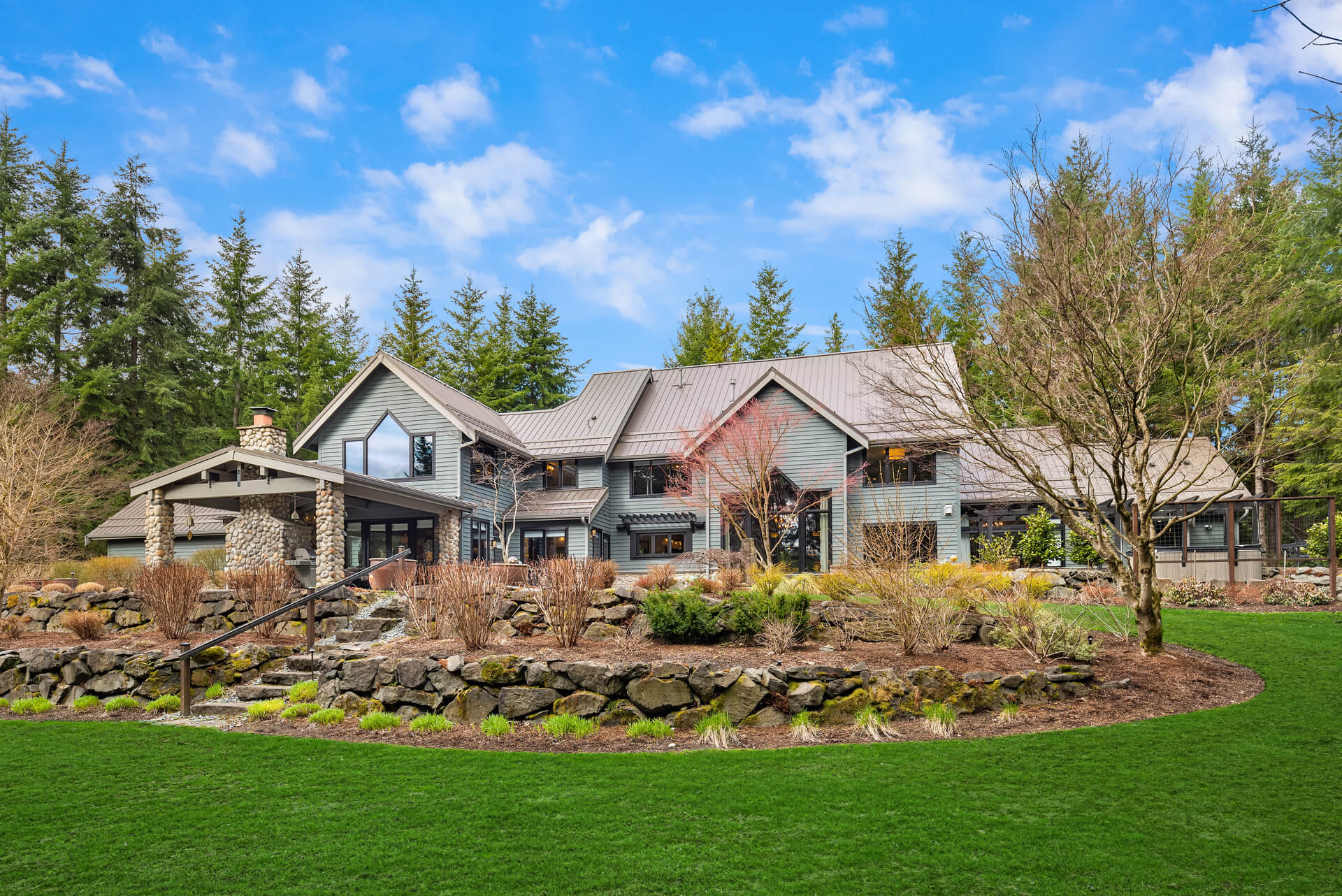
At the median you're generally looking at a four-bedroom single-family home, often built within the past fifteen to twenty years, on a lot between a quarter-acre and an acre depending on the neighborhood. Many have mountain views. Many back to greenbelt or forest.
The same $1.28 million in Bellevue buys an older, smaller home on a considerably smaller lot — or a condo near downtown. That is the trade, stated plainly: space and setting versus proximity and amenity.
Below the median, North Bend still has older homes and smaller lots in the $800,000–$1,000,000 range. Above it, acreage properties and custom homes with significant view or river frontage run well past $1.5 million.
Who North Bend is right for
Right for: buyers whose weekends are spent outdoors, who work on the Eastside rather than in Seattle, who want land and newer construction, and who genuinely like weather. Remote and hybrid workers do especially well here because the commute penalty only applies on the days it applies.
Wrong for: buyers who need to be in Seattle regularly, who want walkable urban amenities, who would find a 30-minute drive for dinner options frustrating, or who want the shortest possible commute.
Worth a second look for: buyers who've been looking in Issaquah and finding the price point difficult. North Bend is 15 minutes further east on the same interstate, and the lot sizes are considerably larger.
Frequently asked questions
What is the median home price in North Bend, WA? $1,284,301 as of mid-2026, up 40.4% year over year. That jump reflects the mix of homes that sold, including newer construction, more than it reflects appreciation on any individual property.
How far is North Bend from Bellevue? About 25 miles east on I-90, roughly 30 minutes off-peak. Rush hour westbound is substantially longer and the corridor has limited alternate routes. Test your actual commute before buying.
Is North Bend a good place to buy in 2026? For buyers who want land, newer construction and mountain access, and whose work is on the Eastside or remote, it remains a strong value relative to Bellevue — though the gap has narrowed to about $215,000 at the median. For buyers who need Seattle proximity or urban amenities, other markets fit better.
How fast do homes sell in North Bend? A median of nine days, at 100.5% of list price. That's a competitive market — buyers should expect to move quickly and should not count on negotiating below asking on a well-priced home.
Does it snow in North Bend? More than in Bellevue. North Bend sits at the base of the Cascades and sees more precipitation year-round and occasional winter snow accumulation. Plan for it in your vehicle choice and your expectations about hillside driveways.
What school district serves North Bend? North Bend is served by the Snoqualmie Valley School District. Confirm assigned schools for a specific address directly with the district — boundaries don't follow city limits and assignments can change.
Let's look at what's actually available
North Bend's inventory is thin and moves fast at nine days. The listings that fit a specific set of requirements — lot size, view, newer build, no flood exposure — are a small subset, and they don't sit.
Tell us what matters most and we'll tell you honestly whether North Bend delivers it at your price point or whether Issaquah, Snoqualmie or the northern valley fits better.
Schedule a consultation with a Tribeca NW agent →
Tribeca NW Real Estate serves buyers and sellers across Bellevue, Kirkland, Redmond, Issaquah, Bothell and the greater Seattle metro. 1,675 homes closed and $1B+ in transaction volume. 500+ five-star Google reviews and 375+ five-star Zillow reviews.
Check out this article next