
Quick answer
For buyers who are financially prepared and plan to stay at least five years, yes. Bellevue's fundamentals are among the strongest of any US housing market. For buyers stretching their budget or likely to move within two to three years, the transaction costs and short-term price risk argue for waiting.
| Signal | Current reading |
|---|---|
| Price direction | Flat to modestly rising (2–4% annually) |
| Inventory | Constrained, under 2 months supply |
| Days on market | 10 – 25 days for well-priced homes |
| Mortgage rates | ~6.0 – 6.5%, gradual easing expected |
| Buyer leverage | Limited but better than 2021–2022 |
| Correction risk | Low absent a major economic shock |
The case for buying in Bellevue now
Inventory is not improving quickly. An estimated 60% or more of Washington homeowners hold mortgages below 4%. Selling means surrendering that rate, which suppresses listings. This lock-in effect erodes slowly, and until it does, supply stays tight.
Waiting has been an expensive strategy. Buyers who paused in 2022 expecting a correction have generally faced both higher prices and higher rates since. The correction many predicted did not arrive.
Lower rates would likely raise prices, not lower them. If rates fall meaningfully, sidelined buyers return to a supply-constrained market. In that scenario prices rise faster than the rate savings. Buying now at a higher rate and refinancing later is a legitimate strategy; the reverse is not available.
The structural supports are durable. Bellevue's value rests on the Bellevue School District, one of the country's strongest; a concentration of major employers including Microsoft, Amazon, Meta, Google, and T-Mobile within short commuting distance; geographic constraints on new supply; and sustained in-migration from higher-cost states.
Buyer leverage is better than it was. Inspection contingencies are being accepted again. Negotiation on price and repairs happens. This was not true in 2021.
The case for waiting
Affordability is genuinely strained. At a $1.6M purchase price with 20% down and a rate near 6.3%, principal and interest runs roughly $7,900 per month before taxes and insurance. Add property tax and insurance and total monthly housing cost approaches $9,500. That requires substantial household income to carry comfortably.
Transaction costs punish short holds. Between closing costs to buy and roughly 7–9% in seller costs to sell — including Washington's real estate excise tax — you generally need several years of appreciation simply to break even. If there is a reasonable chance you move within two to three years, renting is often the better financial decision.
Employment concentration is a real risk. Bellevue's economy is tightly linked to the technology sector. That is a strength in growth and a vulnerability in contraction. A significant, sustained tech downturn would affect Bellevue more than a diversified metro.
Condos are the soft spot. Financing restrictions tied to project eligibility, rising HOA dues, and sharply higher insurance premiums have weighed on condo demand. Well-run buildings are fine. Buildings with thin reserves or pending litigation are not.
What the data actually shows
Prices. Bellevue rose sharply from 2020 through 2022, flattened during the 2023–2024 rate adjustment, and has been stable to modestly rising since late 2024. The current market is the most balanced the region has seen since 2019.
Inventory. Below two months of supply in most segments. Six months is considered balanced. Bellevue remains structurally undersupplied.
Days on market. Well-priced homes in desirable attendance areas still move in 10 to 25 days. Overpriced homes sit — buyers are informed and unhurried.
Segment behavior. Entry-level and mid-market are most competitive. The $1.5M to $2.5M move-up segment is active and healthy. Above $2.5M there is more inventory and longer marketing time. Condos are softest.
Who should buy now
You are likely well-positioned if most of these apply:
- You plan to stay at least five years
- Your housing cost lands near or below 30% of gross income
- You have reserves beyond the down payment
- Your employment is stable
- You have a fully underwritten pre-approval, not just a pre-qualification
- Bellevue School District access matters to your household
- You have clear priorities and can move decisively
Who should probably wait
- You are likely to relocate within two to three years
- The payment requires you to stretch with no reserves
- Your income is newly variable or commission-based
- You have only a pre-qualification letter
- You are buying primarily because you expect rapid appreciation
That last point deserves emphasis. Bellevue is a strong long-term market and a poor short-term speculation. Buy it to live in.
How to buy well in this market
Get fully underwritten pre-approval. Not pre-qualification. Many lenders will underwrite the borrower before a property is identified. This shortens your financing contingency and strengthens your offer substantially.
Verify school attendance by exact address. Bellevue addresses can fall in the Bellevue, Lake Washington, or Issaquah district. Boundaries do not follow neighborhood names. This single verification prevents the most expensive mistake buyers make here.
Look at the value neighborhoods. Crossroads, Lake Hills, Factoria, and Eastgate offer BSD access at meaningfully lower price points than West Bellevue or Somerset.
Consider Redmond and Issaquah honestly. Redmond delivers comparable homes $400,000 to $700,000 below Bellevue in the Lake Washington School District. Issaquah and Sammamish offer the Issaquah School District — a near-peer to BSD on academic metrics — at a similar discount.
Do not waive the inspection contingency reflexively. You can compete without surrendering the protection that matters most on a 40-year-old home.
Drive the commute. At the actual hour you would drive it. Distance on a map tells you very little in this metro.
Common questions
Will Bellevue home prices drop in 2027? A significant decline is not anticipated absent a major economic shock. Supply constraints, employment strength, and in-migration support current values. Most forecasts project modest appreciation.
Is the Bellevue housing market going to crash? The fundamentals differ substantially from 2007. Lending standards are far stricter, low-documentation and adjustable-rate products are a small share of the market, homeowner equity is strong, and the supply shortage is structural rather than speculative. A crash is not the base case.
Is it better to rent or buy in Bellevue right now? If you will stay five or more years and can carry the payment comfortably, buying generally wins. If you may move within two to three years, renting usually wins after transaction costs.
What is the median home price in Bellevue? Roughly $1.5M to $1.8M for single-family homes as of September 2026. Condos run roughly $550,000 to $950,000.
Should I wait for interest rates to drop? Falling rates typically bring more buyers into a supply-constrained market, pushing prices up faster than the payment savings. You can refinance a rate; you cannot renegotiate a purchase price after the fact.
What is the most affordable part of Bellevue? Crossroads, Lake Hills, and Factoria generally offer the lowest entry points while remaining in the Bellevue School District.
Get a straight answer for your situation
The honest answer to "should I buy now" depends on your timeline, your income stability, and your specific priorities — not on a market average. We are glad to walk through it with you, including telling you when waiting is the better call.
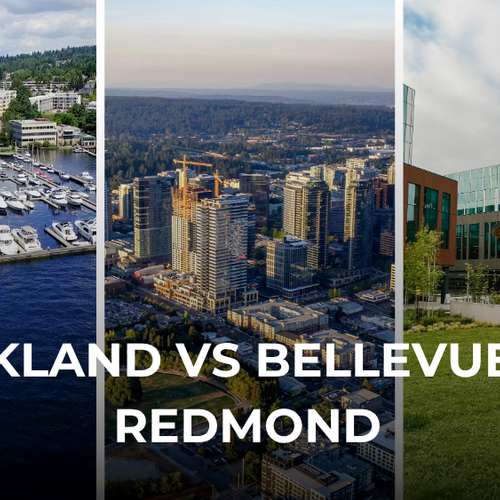
Related reading: Seattle housing market predictions through 2027 → | How much is my home worth in Bellevue? → | Kirkland vs. Bellevue vs. Redmond →
About Tribeca NW Real Estate
Tribeca NW Real Estate is a top-producing brokerage headquartered in Bellevue, Washington, led by Designated Broker Jeff Costello. The team has closed 1,675 homes representing more than $1 billion in transaction volume, with 875+ five-star reviews on Google and Zillow.
This article reflects conditions as of September 2026 and represents analysis, not a guarantee or investment advice. Markets are affected by factors that cannot be predicted.
Check out this article next